
Rethinking Women’s Political Participation in Balochistan

On 26 April 2022, Shari Baloch carried out a suicide attack outside the Confucius Institute at the University of Karachi. The attack was claimed by the Baloch Liberation Army-Jeeyand (BLA-J), and was reported as the first recorded instance of a female suicide bomber within the contemporary Baloch insurgency.

The attack rekindled debate around the trajectory of the Baloch insurgency and raised concerns about security and regional stability. Meanwhile, significant discussion revolved around the profile of the attacker herself. Educated, middle-class, a schoolteacher, and a mother of two,1 Shari Baloch became the subject of a different set of questions. Media coverage in Dawn, Print, Jamestown Foundation among others spent considerable time deliberating who she was and how someone with her background had come to carry out such an attack.
In November 2025, Zareena Rafiq was reported to have carried out a suicide attack on behalf of the Baloch Liberation Front (BLF). Her case further expanded the reported involvement of women in militant operations associated with the Baloch insurgency. The distinction between the number of female attackers and the number of militant organisations involved should, however, be kept clear.4 Reports surrounding BLA's Operation Herof Phase II in 2026 also pointed to the participation of women in combat and suicide missions.
Disappearances as Entry into Public Life
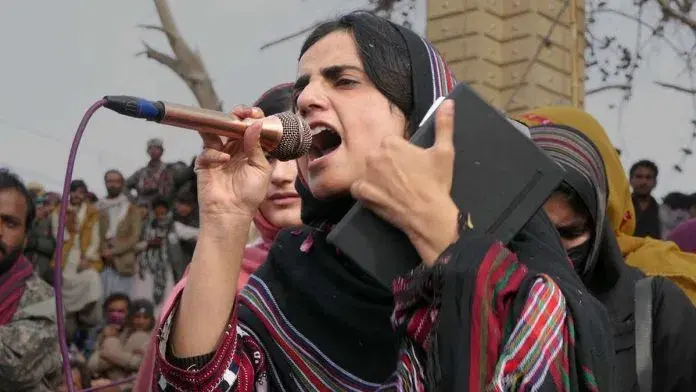
Women, however, have made room for themselves in Baloch politics through other routes as well. Some of the most recognisable faces of contemporary Baloch nationalism are associated with campaigns around enforced disappearances and missing persons. Activists such as Mahrang Baloch and Beebow Baloch have emerged as prominent voices campaigning against enforced disappearances, alleged extrajudicial killings, and militarisation in the province.
For many Baloch families, searching for a disappeared relative has become a recurring pathway into public and political life. Mothers searching for sons, daughters demanding justice for fathers, and sisters mourning brothers are a common occurrence. For many women, this search becomes a substantial engagement with public and political life for it leads them to courts, protest camps, press conferences, and long marches.
The Broader Political Context
Several high-profile incidents have contributed to public anger in Balochistan, including the killing of Hayat Baloch in 2020 and the custodial death of Balach Mola Baksh, which was followed by protests across several districts. The circumstances surrounding other reported killings, including that of Malik Naz, should be sourced separately if retained in the final version.
The contemporary and fifth phase of the Baloch conflict is often associated with demands for greater political rights, control over natural resources, provincial autonomy, and opposition to China-Pakistan Economic Corridor (CPEC) projects. It has become intertwined with allegations of enforced disappearances, arbitrary detention, and state repression.
The mobilisation around disappearances often segues into a broader scrutiny of rights, accountability, and the relationship between Balochistan and the Pakistani state. In recent years, activists associated with campaigns around disappearances have been arrested, detained, and trapped in legal proceedings. Mahrang Baloch and Beebow Baloch were detained following protests in Quetta in 2025. Human rights organisations have raised concerns about their treatment in custody, access to medical care, and the use of anti-terror legislation against activists whom they describe as peaceful.
Student Politics
Student politics appears repeatedly in the backgrounds of many prominent Baloch activists. Karima Baloch, one of the most recognisable voices in contemporary Baloch nationalism, entered active politics through the Baloch Students Organisation (BSO) and later became the first woman to chair its Azad faction. Mahrang Baloch was similarly involved in student activism at Bolan Medical College prior to leading the Baloch Yakjehti Committee (BYC). In 2024, she publicly criticised the closure of Bolan Medical College and its hostel, describing it as an attack on education and an attempt to militarise academic spaces in Balochistan.
The BSO has historically served as an important space for political mobilisation around questions of disappearances, political rights, autonomy, and resource control.
The prominence of students and professionals has led several observers to distinguish this phase of the conflict from earlier periods of insurgency. Ayesha Siddiqa argues that recent phases of Baloch nationalism draw support from an educated and urbanised Baloch middle class rather than being associated solely with tribal leadership. Notice the different trajectories: Shari Baloch was a schoolteacher; Mahrang Baloch is a doctor; and Hawa Baloch was described by the BLA as a writer and intellectual. Their political trajectories and forms of mobilisation are hardly identical. Their educational and professional backgrounds are notable because they complicate assumptions that women participating in Baloch political mobilisation necessarily come from socially or economically marginal backgrounds.
Making Sense of the Woman Militant
If women are increasingly visible across different forms of political participation, how should the woman militant be understood? The arrest of a woman whom Pakistani authorities identified as a would-be suicide attacker in 2026 produced sharply competing narratives.
Pakistani authorities presented her participation through a narrative of recruitment, radicalisation, manipulation and coercion. Militant organisations, by contrast, have sought to frame women's participation in terms of political conviction and individual agency.

Shari Baloch was portrayed by militant sources as an educated woman acting out of political conviction, while Asifa Mengal was described in media accounts as a volunteer who had committed herself to the Majeed Brigade and a suicide mission. These competing accounts raise a broader question about how women involved in militancy are understood: as victims, recruits, symbols, or political actors.
Figures such as Shari Baloch, Hawa Baloch and Asifa Mengal capture unique attention because they reveal that certain forms of women’s political participation are more elusive than others. Women have been active for years in campaigns around disappearances, in student politics, and in nationalist work. That said, a woman in a militant role often prompts a different kind of scrutiny, focused on her background, recruitment, and whether she acted out of conviction or pressure.

These forms of political engagement should not, however, be treated as interchangeable. Peaceful activism, student politics, nationalist mobilisation and participation in political violence differ fundamentally in their methods, legitimacy and consequences. Examining the conditions and narratives surrounding women's participation in militancy is therefore not an endorsement or justification of political violence or attacks on civilians.
The image of the grieving female relative still carries force, but it no longer accounts for the range of roles women are actually occupying. A daughter searching for a disappeared father can end up leading protests. A student activist can become a recognisable voice in the movement. A woman can also become involved in an armed organisation, although this represents a fundamentally different form of political engagement. These are different pathways into public and political life, shaped by overlapping but not identical social and political conditions.
Shari Baloch’s case keeps returning in discussions of the current phase for a reason. She belongs to a moment where stepping forward, whether in protests, student groups, or armed actions, is repeatedly described in similar social terms. Across these roles, women challenge the binaries of male militant and grieving female relatives and complicate conventional assumptions about gender, agency and political participation. The attention given to female militancy may therefore reflect not only the violence of the acts themselves, but also the challenge they pose to conventional understandings of women's political agency.
This analysis seeks to understand the conditions, narratives and forms of political mobilisation associated with women's participation in Balochistan; examining these dynamics should not be read as an endorsement or justification of political violence or attacks on civilians. The views and opinions expressed in this article are those of the author and do not necessarily reflect the views, positions, or institutional perspectives of the Centre for Gender and Politics (CGAP) South Asia.
Author:

Pali Pranjal is a Master's student in International Relations at South Asian University. Her interests span gender and politics, political institutions, war and conflict, and South Asian affairs. She writes on questions of power, representation, and political change, with an interest in how societies and institutions evolve.
Special Credits:
Editorial Support: This piece was reviewed by Prof. Suman Singh, Editorial Head, Centre for Gender and Politics & edited by Riya Hira to ensure factual accuracy, contextual sensitivity, and coherence with an analytical perspective on gender, politics, and conflict.
Sources:
Dawn Editorial, “An Unlikely Profile,” April 28, 2022.
Abdul Basit, "A Profile of Shari Baloch: The First Baluch Female Suicide Bomber," Militant Leadership Monitor 13, no. 7 (2022), Jamestown Foundation, 5 August 2022.
Dawn Editorial, "An Unlikely Profile," Dawn, 28 April 2022; Ayesha Siddiqa, "Karachi Suicide Attack Gives New Wing to Baloch Insurgency. Pakistan Can't Ignore It Anymore," The Print, 11 May 2022; Abdul Basit, "A Profile of Shari Baloch: The First Baluch Female Suicide Bomber," Militant Leadership Monitor, Jamestown Foundation, 5 August 2022.
Imtiaz Baloch, "Zareena Rafiq Becomes Fifth Baloch Female Suicide Bomber," Militant Leadership Monitor 17, no. 2, Jamestown Foundation, 19 February 2026.
News Vibes of India, "Balochistan: 'Operation Herof 2' Highlights Extraordinary Stories," 3 February 2026.
Front Line Defenders, "Beebow Baloch"; Amnesty International, "Pakistan: Baloch Activists Face Secret Trials and Ongoing Detention," 20 March 2026.
Kiyya Baloch, "Why Pakistan's Once Little-Known Baloch Insurgency Now Matters in Washington," Small Wars Journal, 14 April 2026.
Ayush Verma, Imtiaz Baloch, and Riccardo Valle, "The Baloch Insurgency in Pakistan: Evolution, Tactics, and Regional Security Implications," CTC Sentinel 18, no. 4, April 2025.
Amnesty International, "Pakistan: Baloch Activists Face Secret Trials and Ongoing Detention," 20 March 2026.
Baloch Students Organization-Azad, "Martyr Banuk Karima Baloch: The Leader of Generations," 21 December 2024.
ANI, "Baloch Activist Condemns Closure of BMC College and Hostel, Calls It 'Attempt to Militarize Academic Spaces in Balochistan'," The Print, 14 December 2024.
Ayesha Siddiqa, “Karachi Suicide Attack Gives New Wing to Baloch Insurgency. Pakistan Can’t Ignore It Anymore,” The Print, May 11, 2022.
Moohita Kaur Garg, "Pakistan's Insurgency Takes a Shocking Turn as BLA Unveils Women Attackers; Who Are Asifa Mengal and Hawa Baloch?," WION, 2 February 2026.
Saleem Shahid, “Would-be Female Suicide Bomber Narrates Ordeal at TTP-BLA Hands,” Dawn, March 19, 2026.
Picture Credits:
Vecteezy
This article is published under CGAP Blogs. Our blog is a space for practitioners, researchers, policymakers, & advocates to share perspectives on gender and politics across South Asia in a language that is accessible, grounded, and worth reading.
CGAP, Centre for Gender and Politics, is a think tank that works at the intersection of women, politics, & South Asia to produce high-quality research & push for narratives of women as leaders, and not as victims. Our work includes Beyond Victims, Worth Asking, and the Parliamentary Readiness Review.
Read our previous publications, here.


Comments